The first invoice has been paid and the money sits on the same account as the rent and the groceries. That works, until the first VAT return (btw-aangifte) comes round and every incoming payment has to be sorted out. Then the question arises by itself: is it mandatory to open a business account, or can everything keep running through the private account? The answer depends on the legal form. And on what the terms and conditions of your own bank say.
Below are the rules per legal form and what the KVK (the Dutch Chamber of Commerce) and the Belastingdienst (the Dutch tax authority) say about it. After that come the case without a KVK registration, the reasons to separate anyway and the steps to open an account.
In short:
- Is a business account mandatory? Not for an eenmanszaak (sole proprietorship), vof, maatschap or cv: no law requires it, and the Belastingdienst does not require it either.
- A bv or nv (private or public limited company) does need a business account in practice, in the name of the legal entity. The same applies to an association or foundation.
- Many banks do not allow business use of a private account in their terms. If the bank sees a lot of business transfers, it can ask for a business account to be opened after all.
- What is mandatory: keeping records and retaining them for 7 years, bank statements included.
What does the law say about a business account?
No law obliges a zzp’er (freelancer) or eenmanszaak to open a separate account. The Belastingdienst puts it plainly (translated): “We do not oblige you to take out a business bank account, but it is extremely useful.” The KVK ties the answer to the legal form: whether a business account is mandatory depends on it. With an eenmanszaak, the business is not a separate person in law. Owner and business share one set of assets, so the money may sit in one account.
Still, there is something to arrange. Every entrepreneur has to keep records from which the Belastingdienst can see which income and expenses belong to the business. That is the practical side of the question: the more private and business payments run together, the more sorting it takes to separate them afterwards. Seen this way, a business account is not a duty, but the tool that makes the real duty take less time.
Record-keeping and retention duty
Is a business account mandatory for the Belastingdienst? No, but the records the Belastingdienst wants to be able to inspect are. They include bank statements, invoices received and copies of invoices sent. The basic records, such as the general ledger and the purchase and sales records, are kept for 7 years; records on real estate for 10 years. Every amount debited or credited to the account needs a receipt or invoice. If business items run through the private account, those private statements become part of the records just the same.
Business account mandatory by legal form
The answer shifts as soon as the business itself is a legal entity. A bv or nv has its own rights and obligations and its own money, separate from the owner’s private assets. Banks usually open an account in the name of the legal entity for these legal forms, which is why a business account is indispensable there in practice. Is a business account mandatory for an eenmanszaak? No, and the same goes for a vof, maatschap or cv.
| Legal form | Business account mandatory? | What applies in practice |
|---|---|---|
| Eenmanszaak (including zzp’ers) | Not by law | A private account is allowed if the bank’s terms permit business use |
| Vof, maatschap, cv | Not by law | Not mandatory, but recommended by the KVK |
| Bv, nv | In practice, yes | Account in the name of the legal entity, private and business kept separate |
| Association, foundation | In practice, yes | An account can only be opened after registration with the KVK |
In a vof, maatschap or cv, two or more partners work together. A business account is not mandatory there, but the KVK does recommend one. Partners who share income and costs benefit from one place where all payments of the partnership come together. Then the profit split at the end of the year does not have to be built up from several private statements.
In summary: without a legal entity there is no legal duty, and an eenmanszaak, vof, maatschap or cv may use a private account if the bank allows it. With a legal entity, such as a bv, the money belongs in an account in the company’s name.
Do you need a business account as a zzp’er?
If a zzp’er works with an eenmanszaak, the question whether a business account is mandatory for zzp’ers is quickly answered: no, usually not mandatory. The KVK says so just as briefly in its own FAQ, with one caveat about the bank’s terms. The VAT return does not need a separate account either, although a business account does make it easier to find income and expenses again.
Do you need a business account as an eenmanszaak that is just starting? That is not required either. Starting with the private account and switching later is allowed, says the KVK. It names the signal to switch right away: lots of business transfers and an overview that slips. Anyone who spends longer each quarter puzzling over the return has a practical benchmark there. The switch itself comes down to opening a new account and putting the new IBAN on the next invoice.
Using a private account for business: is it allowed?
Legally yes, contractually often not. Anyone who wants to use a private account for business runs into the bank before the law. Many banks state in their terms that a private payment account is meant for private use only. If the bank sees a lot of business transfers on a private account, it can get in touch and ask for a business account to be opened after all. That is how the KVK describes it, and some banks say the same in their own explanations.
For an eenmanszaak, the choice between a business account or a private one is therefore mostly a matter of checking the terms. These points in the current bank’s terms tip the balance:
If the terms exclude business use, a separate business account leaves room to plan the switch on your own terms, at a quiet moment and not in the middle of a busy month.
Payment services and sales platforms
The question also comes up outside the bank. Payment services such as Mollie, PayPal, Stripe and Klarna ask for a business payment account, and the same goes for online sales channels such as Amazon and Bol. Anyone selling through such a service or platform therefore soon needs a business account in practice, even if the law does not ask for one. For a webshop that takes payments through such services, the account is more of a precondition than a choice.
Business account without a KVK registration
A business account without a KVK registration is difficult in the Netherlands, for a simple reason: banks usually ask for an ID document, the KVK number and information about the business when you apply. The KVK number is also the number you give for business purchases, subscriptions and insurance. Anyone who wants to open a business account without a KVK registration therefore mainly needs the KVK number for that first question from the bank.
On top of that comes the duty to register. Every business in the Netherlands has to be in the Handelsregister (the Dutch business register), zzp’ers and freelancers included. Registration is possible from 1 week before to 1 week after the start, and the KVK number follows straight after registration. According to the KVK, you are an entrepreneur if you independently supply goods or services to others with the aim of making a profit. A hobby that earns little or nothing does not count: the KVK does not register it. Doubts about your own activity are best settled with the KVK’s entrepreneur criteria, before the first invoice.
For entrepreneurs from abroad doing business in the Netherlands, the same line applies. A Dutch business account is not mandatory, according to the KVK. Anyone who wants to open one anyway needs a registration in the Handelsregister in practice, because that is what banks usually ask for.
Why a separate account pays off
An eenmanszaak without a business account can run perfectly well with a handful of jobs a year, if the bank’s terms allow it. As the work grows, the sums change, and a separate account mostly saves time:
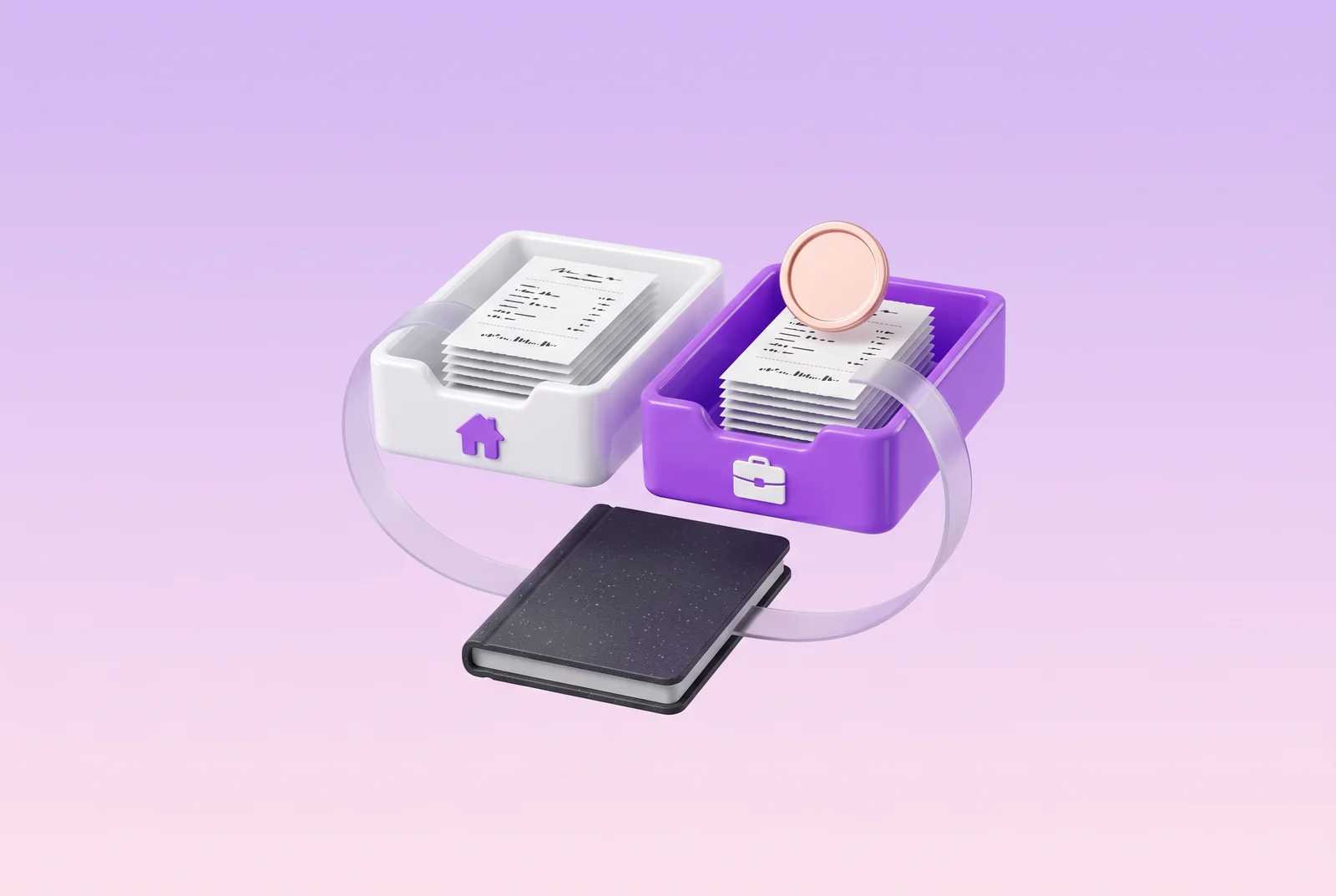
The Belastingdienst names the same advantage: with a business account, personal and business transactions stay separate, and that makes the records easier to follow. It also makes a difference for profit. Money that goes from the private account into the business is not business profit, and private expenses paid from the business are not deductible. With two accounts, that line stays visible at a glance.
Good to know: a private withdrawal has no maximum amount, as long as the money is available in the business. Every withdrawal does belong in the records.
Opening a business account in 4 steps
Opening a business account for an eenmanszaak follows the same order with most providers. With the documents ready in advance, the application is done without back and forth:
Register the eenmanszaak in the Handelsregister, from 1 week before to 1 week after the start. The KVK number follows straight away, and that is exactly the number a bank asks for when you apply for a bank account for the eenmanszaak.
Keep a valid ID document, the KVK number and the business details at hand. If the account will also be used for foreign transactions, the bank often asks for an overview of the countries you do business with.
Choose a provider and a plan and fill in the application. With online providers this is usually fully digital, with an identity check via smartphone.
Put the new IBAN on invoices and quotes, move recurring business payments and link the account to the accounting software. That way the statements are ready for the records from day one.
Vivid for zzp’ers and sole proprietors
Vivid Business is built for entrepreneurs who manage their business money online. For an eenmanszaak there is a business account for freelancers with a Dutch IBAN, and the Standard plan costs €0 per month. The application usually takes about 10 minutes, fully online and without a branch visit. Opening the account itself usually takes 10 minutes to 1 hour.
What each plan adds is on the business account page.
Vivid in short: a business account with a Dutch IBAN, invoicing and sub-accounts in one app, for sole proprietors from €0 per month on the Standard plan. The application is online and usually takes about 10 minutes.
A business account for freelancers
Keep business and private separate from the first invoice: Dutch IBAN, invoicing and Visa debit cards in one app. The Standard plan costs €0 per month.
Frequently asked questions
Is a business account mandatory for an eenmanszaak?
No. No law obliges an eenmanszaak to have a separate business account, and the Belastingdienst does not require one either. A private account is allowed, as long as the bank’s terms permit business use. Many banks do exclude that. On top of that, many zzp’ers choose a business account because it gives more overview and makes the bookkeeping simpler.
Do you need a business account for the VAT return?
No. The VAT return does not require a business account. A separate account does make it easier to find the income and expenses that belong in the return.
Can you start with a private account and switch later?
Yes. With an eenmanszaak you can start with the private account and open a business account later, for example once the number of business transfers grows. The bank’s terms are worth reading: many banks do not approve of business use of a private account.
Can you open a business account without a KVK registration?
Usually not. Banks generally ask for the KVK number in the application. Every business, including that of a zzp’er, also has to register in the Handelsregister, no later than 1 week after the start. A hobby that earns little is not a business according to the KVK and is not registered.
Is a business account mandatory for a bv?
In practice, yes. A bv is a legal entity with its own money, separate from the owner’s private assets. Banks therefore usually open an account in the name of the bv. The same applies to an nv, an association and a foundation.
Which documents does a bank ask for a business account?
For an eenmanszaak usually a valid ID document, the KVK number and information about the business. If the account will also be used for foreign transactions, an overview of the countries you do business with is often added. By law, banks have a gatekeeper role: they check who they do business with, and that is why they ask for these documents.
How long do you keep the business’s bank statements?
Bank statements are part of the records, and those are kept for 7 years. For records on real estate it is 10 years. For other records, a shorter period can be agreed with the Belastingdienst.
This article provides general information and is not legal, tax or accounting advice. The rules mentioned are as published by the KVK and the Belastingdienst and may change. Vivid’s payment services are provided by Vivid Money S.A., an electronic money institution authorised and regulated by the Commission de Surveillance du Secteur Financier (CSSF) in Luxembourg; its Dutch branch is registered with De Nederlandsche Bank (DNB) as an electronic money institution. Brand names mentioned belong to their respective owners.