
You have registered with the Crossroads Bank for Enterprises (CBE), the enterprise number has arrived and the first invoice is waiting to go out. One line at the bottom of the document is still empty: the account number. Do you need a business account in Belgium for that line, or does the usual personal account do the job? The answer depends mainly on the legal form: a natural person and a company are not subject to the same rules.
The answers come from four official sources: the Code of Economic Law, the Code of Companies and Associations, the federal portal business.belgium.be and the VAT form of the FPS Finance. Then come the reasons to keep accounts separate and the steps to open a business account in Belgium, online if you prefer.
Key points at a glance:
- For a sole proprietorship, a separate business account is not mandatory, but business.belgium.be strongly advises one to keep private and business transactions apart.
- A business account is mandatory for a company: the account in the company’s name is opened before the deed of incorporation is drawn up.
- Invoices, letters and other documents of the business state the number of at least one payment account. Since 26 January 2023, that account can be held outside Belgium: the text refers to a payment account opened with a banking institution established in the European Economic Area and covered by Directive (EU) 2015/2366.
- Cash contributions to an SRL, an SC or an SA go through a special account, opened in the name of the company in formation with a credit institution.
- The application for VAT identification has a field for the account that receives VAT refunds.
Is a business account mandatory in Belgium?
The official answer is on business.belgium.be, the federal one-stop portal for businesses. On its page about the sole proprietorship, the site states that a sole trader is not legally obliged to open a separate professional bank account, unlike companies. A business bank account in Belgium is therefore a choice for a natural person and a fixed step for a company. The table sums up the rules by legal form.
| Legal form | Separate account | What the texts provide |
|---|---|---|
| Sole proprietorship (natural person) | Not mandatory, strongly advised | Number of at least one payment account on the business’s documents (CDE, Art. III.25) |
| SRL | Mandatory, in the company’s name | Account opened before the deed of incorporation, cash contributions on a special account (CSA, Art. 5:9) |
| SA | Mandatory, in the company’s name | Minimum capital of €61,500, cash contributions on a special account (CSA, Art. 7:12) |
| SC | Mandatory, in the company’s name | Sufficient starting equity (business.belgium.be), cash contributions on a special account (CSA, Art. 6:10) |
One rule applies to all these forms: the business’s documents show an account number. For a natural person, that line can point to the private account. For a company, it points to the account opened in its name, which makes the legal form the real starting point.
Self-employed as a natural person: the rules
Under the Code of Economic Law, a natural person who carries on a professional activity on a self-employed basis is an enterprise, just like a company. That person registers with the Crossroads Bank for Enterprises before starting and receives an enterprise number. A bank account for the self-employed, in the sense of an account reserved for the business, is not one of these formalities. The law focuses on something else: the account number shown on documents. A business account for the self-employed therefore stays an organisational decision, not a condition for trading.
The account number on invoices and documents
Article III.25 of the Code of Economic Law covers all deeds, invoices, announcements, communications, letters, orders and other documents of enterprises registered with the CBE. They always state the enterprise number. Since the law of 25 September 2022, in force from 26 January 2023, they also state the registered address and the number of at least one payment account held by the enterprise, opened with a banking institution established within the European Economic Area and covered by Directive (EU) 2015/2366.
Before this reform, the text required an account with a credit institution established in Belgium. The explanatory memorandum of the bill explains the change: no longer requiring an account in Belgium and allowing, in particular, a SEPA account to be stated, to comply with the European Services Directive. In practice, the “account number” line of an invoice can now point to a payment account opened in another country of the European Economic Area, with a banking institution covered by Directive (EU) 2015/2366.
Private account or separate account
For a sole proprietorship, the account stated can be the private account: the law refers to an account held by the enterprise, and the natural person is the enterprise. business.belgium.be asks whether a private account can be used for a sole proprietorship and answers that there is no obligation, together with clear advice: keep private and business transactions separate.
The same site gives a concrete reason. The account number appears on all business documents, next to the enterprise number and the business name. With a separate account, that is the number clients and suppliers see, and the personal account stays off the invoices.

The account in the CBE and for VAT
The Crossroads Bank for Enterprises can record a business’s account data: Article III.18 of the Code of Economic Law lists data relating to the bank account(s) among the registration data, and the CBE breaks these data down into the use of the account, the BIC and the IBAN. The FPS Economy states that the bank account number is one of the details a business can add, change or delete itself in the CBE through the My Enterprise application.
On the VAT side, the application for identification (form 604A, filed online) has a section for the account, BIC and IBAN, into which the FPS Finance pays VAT refunds, with a box stating that the account belongs to the business. The explanatory notes specify that this entry is not needed without periodic returns and without a possible refund. A new account is reported later with the amendment form 604B.
SRL, SA, SC: an account in the company’s name
For a company, the account question comes up before it even exists. business.belgium.be puts it plainly: a bank account in the name of the company is opened before the deed of incorporation is drawn up. After that, it is the number of this company bank account that appears on its documents under Article III.25.
The special account for cash contributions
When partners contribute money to an SRL, Article 5:9 of the Code of Companies and Associations sets the route. Before incorporation, the funds are paid into a special account opened in the name of the company in formation, with a credit institution established in the European Economic Area. Proof of this deposit goes to the notary who executes the deed.
This special account is reserved for the company to be formed. The persons authorised to bind the company can use it once the notary has informed the institution that the deed has been executed. If the company is not formed within a month of the account being opened, the funds are returned, on request, to those who deposited them. For the SC and the SA, Articles 6:10 and 7:12 provide the same mechanism.
Equity and financial plan
Since the Code of Companies and Associations, the SRL is a company without capital: there is no longer a minimum amount. The founders do, however, make sure that at incorporation it has starting equity that is sufficient in light of the planned activity. They hand the notary a financial plan that justifies this amount over at least two years: a description of the activity, sources of financing, an opening balance sheet, projected balance sheets at 12 and 24 months, an income statement and a budget of income and expenses. The notary keeps this document; it is not filed with the deed.
The SA keeps a minimum capital of €61,500, fully paid up at incorporation, and each share issued for a cash contribution is paid up by at least one quarter. For the SC, business.belgium.be points to the requirement of sufficient starting equity. For cash contributions, the funds go through the special account opened in the name of the company in formation with a credit institution before the deed is signed (CSA, Art. 5:9 for the SRL, 6:10 for the SC, 7:12 for the SA).
Why keep accounts separate, even without an obligation
For a sole proprietorship, a business current account remains optional, and yet the federal portal recommends one. business.belgium.be names two advantages: protecting private data, since the account number appears on all business documents, and making the bookkeeping easier, since private and business transactions are kept apart. In practice, the separation shows at several points:
A separate account changes nothing about the legal obligations of the natural person. What it changes is how readable the figures are, and that clarity shows from the first year of trading.
Opening a business account in Belgium: the steps
The route differs by legal form, but the logic stays the same. To open a business bank account or a payment account for the business, the enterprise gathers its details, has the identity of its managers checked, then copies the new number wherever it has to appear.
A sole proprietorship chooses between its private account and a separate account. A company opens the account in its name before the deed of incorporation is drawn up.
A valid ID for each person involved, plus the enterprise number if there is one. The address and the activity follow, and for a company its documents and the details of its managers.
The application is made in a branch or online, depending on the provider, with an identity check of the people who represent the business.
The account number goes on the invoices, letters and other documents of the business, next to the enterprise number and the registered address.
Account details are recorded in the CBE through My Enterprise. For VAT, the refund account is part of the 604A application or is changed with form 604B.
In short: a sole proprietorship can use its private account, but gains clarity with a separate one. A company opens an account in its name from the start and routes its cash contributions through a special account.
Opening a business account online
Opening a business account online in Belgium needs no appointment. The Vivid account is for businesses already registered with the CBE, self-employed people or companies that are already formed. The special account for cash contributions, for its part, is opened before the deed with a credit institution.
At Vivid, the application takes around ten minutes. It needs a valid proof of identity, such as an ID card or passport, and information about the business, including its legal form, its address and its sector of activity. Identity is verified with a selfie and the ID document. Opening the account generally takes between 10 minutes and 1 hour, and for a company, Vivid asks that all managers live in a country of the European Economic Area or in Switzerland.
An online business account with Vivid
Vivid offers an online business account to Belgian businesses that are already formed, from the self-employed to companies. Opening the account is free, and the application is 100% online, with no branch visit. What the account offers:
Even on the plans with no monthly fee, some services can incur fees depending on the plan, for example an inactive card (Free Start), topping up the account by card or a cash withdrawal above the included amount. From the second physical card, standard delivery costs €9.90. The details per plan are on the plans page.
Vivid in brief: Vivid Money S.A. is an electronic money institution authorised in Luxembourg, which opens business accounts online for the self-employed and companies already formed in Belgium.
The online business account for your business
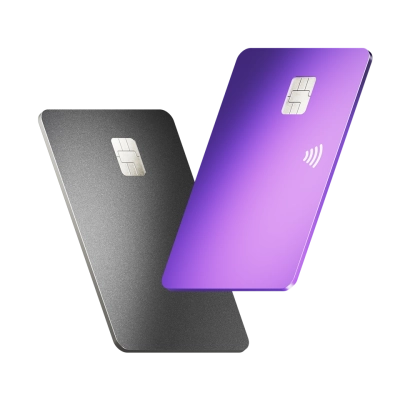
An online business account for a sole proprietorship as well as an SRL that is already formed: unlimited IBANs, invoicing included and Visa debit cards. The application takes around ten minutes.
Frequently asked questions
Is a business account mandatory for the self-employed in Belgium?
No. According to business.belgium.be, a sole proprietorship is not legally obliged to open a separate professional bank account. The site does, however, advise doing so to keep private and business transactions apart.
Does an SRL need an account in the company’s name?
Yes. business.belgium.be states that a company opens an account in its name before the deed of incorporation is drawn up. Cash contributions to the SRL go through a special account opened in the name of the company in formation.
Can the account stated on invoices be held abroad?
Since 26 January 2023, Article III.25 of the Code of Economic Law no longer asks for an account in Belgium. The text refers to a payment account opened with a banking institution established within the European Economic Area and covered by Directive (EU) 2015/2366.
Which account number goes on a Belgian invoice?
The number of at least one payment account held by the business, together with the enterprise number and the registered address. For a sole proprietorship, it can be the private account of the natural person.
Where are an SRL’s cash contributions deposited?
In a special account opened in the name of the company in formation with a credit institution established in the European Economic Area, before incorporation. Proof of the deposit goes to the notary (Article 5:9 of the Code of Companies and Associations).
Does an account number have to be given for VAT?
The application for VAT identification has a field for the account that receives VAT refunds. According to the FPS Finance notes, this field is not needed without periodic returns and without a possible refund.
Can a business account be opened online in Belgium?
Yes, for a business already registered with the CBE. At Vivid, the application is made online in around ten minutes, with an ID document and the information about the business. Opening generally takes between 10 minutes and 1 hour.
This article is for general information only and does not constitute legal, tax or accounting advice. The rules cited are those published on Justel (Code of Economic Law, Code of Companies and Associations), business.belgium.be and by the FPS Finance, and may change. Payment services are provided by Vivid Money S.A., an electronic money institution authorised and regulated by the Commission de Surveillance du Secteur Financier (CSSF) in Luxembourg.