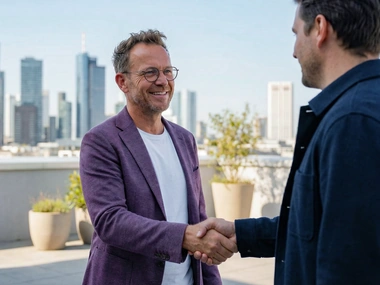
I liked that Vivid comes from Berlin, so there is a basic level of trust. With other neobanks, you have to check whether they are safe. A bank rooted in Germany is reassuring.
Alexander, Head of Sales & Marketing, Wilhelm Studios

What began as a derelict iron foundry (Eisengießerei) in Berlin’s Reinickendorf district is today one of the city’s most sought-after venues for corporate events, product launches, and cultural events. Wilhelm Studios came to market in 2019, survived the pandemic that shuttered the entire event industry, and has since built a client base spanning Germany’s largest corporations, major event agencies, and the Berlin art world.
Alexander, who leads Sales and Marketing at Wilhelm Studios, came to Vivid on straightforward terms: the best daily interest rate available. What he found was a bank that met the bar he applies to every tool he puts to regular use: transparent, trustworthy, and built for people running a real business.
Four landmark brick buildings, all under heritage protection (Denkmalschutz), house more than 8,000 square meters of modular event space, capacity for 50 to 1,600+ guests. A further 1,000 square meters of outdoor space extends the site, lit up at night into something genuinely spectacular. Panoramic glass ceilings, underfloor heating, full insulation, and state-of-the-art technical infrastructure make the whole complex functional year-round and suitable for the most demanding productions.
Alexander, who leads Sales and Marketing at Wilhelm Studios, came to Vivid on straightforward terms: the best daily interest rate available. What he found was a bank that met the bar he applies to every tool he puts to regular use: transparent, trustworthy, and built for people running a real business.
From Iron Foundry to 8,000 Square Meters of Corporate Possibility
The special charm of this location is precisely that it has this old industrial architecture, but it has been completely renovated. Underfloor heating. Thermal insulation. The latest event technology. You can run the most demanding events here.
Event agencies and corporations book the space; the Wilhelm Studios core team of eight, all with creative and event-industry backgrounds, handles everything around it. When a major production arrives, that team expands significantly, pulling in the extra hands needed to make it happen. Permanent tenants add a further layer of life to the site: a gallerist, two architecture firms, artist studios, and the Deutsche Symphonie-Orchester make it a living creative district, not just a rentable hall. On still afternoons, when a rehearsal window opens, music drifts across the courtyard. During Berlin Art Week, the venue has become an essential stop for anyone serious about the city’s cultural scene.
When there is an event here, all the installations are set up, the bars are in place, and the lights come on at night. It really looks extraordinary.
Alexander, Head of Sales & Marketing, Wilhelm Studios

What Draws Corporate Clients to Berlin
Senior executives planning an offsite or product launch face the same question: what does the venue say about the company? A hotel ballroom communicates reliability. Wilhelm Studios communicates ambition, creative edge, and a real understanding of what makes Berlin different.
Alexander traces that value to a specific historical moment. After the Wall fell, Berlin’s clubs moved into derelict industrial buildings: the Tresor, the E-Werk, the spaces that defined the city’s creative identity. That spirit has long since been commercialized. He does not pretend otherwise.
“Of course it has been commercialized. Everyone knows that,” he says. “But that conscious awareness allows a relaxed relationship to it. Ultimately, it is not about whether it is authentic in the old sense. It is about delivering inspiration, making people feel, when they leave, that they’ve taken something away they didn’t expect when they arrived.”
Inscribed on the venue wall, visible to every guest who walks through, is a phrase that doubles as both architectural motto and operating philosophy: always becoming, never simply being. For any event brief that reads make our people feel something, that is a precise and commercially valuable promise.
Why Berlin Still Belongs to the Creative Class
Alexander is not a neutral observer of Berlin’s creative mythology. He grew up in the DDR and experienced the fall of the Wall as, in his words, “the greatest lucky moment of my life.” What had been sealed off suddenly opened. The sensation did not produce nostalgia so much as a permanent appetite for new horizons, a motor he has carried into every professional chapter since.
“I still have that enthusiasm for freedom, in the here and now,” he says. “I’m not looking backwards. I’m always looking forward to what tomorrow will bring.”
That perspective shapes how he reads the city for his clients and his creative peers. Berlin, he observes, still draws young creatives who are financially finding their feet, because the commercial pressure here remains lower than in London, New York, or Zurich. You can try something, stumble, and try again. That is not an accident; it is a structural feature of a city that has been reinventing itself, in one form or another, for generations.
“The more you are away from Berlin, the more creative the image becomes,” he says. “People in Zurich, in New York, they have a specific picture of this city. The further away they are, the more it becomes a cliché, but also the stronger the signal. That creative impulse coming from here is still alive, at least in people’s minds.”
For businesses booking Wilhelm Studios, this is part of what they are paying for: not just square meters, but the right to borrow Berlin’s reputation for a day.
The Entrepreneur Who Keeps Opening Unfamiliar Doors
Before events, there was film. Alexander worked as a producer and then director on Bollywood productions in Mumbai, drawn in not by fandom but by the sheer strangeness of the territory. What surprised him most was how familiar it felt once he was on set. Film professionals in India operate by the same procedures as in America; the same meetings, the same sequences, the same professional logic. Creatives worldwide, he concluded, speak a common language beneath the surface differences.
He spent three seasons producing content for Germany’s Next Top Model on ProSieben, a job that required founding his own film production company and shooting across four continents: Mumbai, Rio, São Paulo, Tahiti, Los Angeles. When ProSieben’s legal team blocked access to a Rio favela during Carnival, he found a path through a conversation with the city’s mayor. The location was officially a comunidad, a term absent from the prohibited list. The shoot went ahead. The community welcomed the crew with a warmth Alexander still describes as one of the finest productions of his career.
“I realized it is always worth pushing not just to the limits but beyond them,” he says. “When you truly believe in something and know it is worth it, you can walk through walls.”
It was precisely that track record (production, creativity, advertising, marketing across industries and continents) that introduced him to the founders of Wilhelm Studios. They discovered immediately that they were on the same wavelength.
His advice to younger creatives entering the industry is direct: never stop being ambitious, stay ready to fight, and treat every obstacle as part of the game, not something to resent, but the thing that makes the work worth doing. “Without curiosity, you cannot be creative,” he says.
“Creativity comes from curiosity, from opening a door without knowing what is behind it, and committing to figuring it out.”
He also knows the limits of relentless novelty-seeking. “If every day consists only of new challenges and enormous hurdles, it wears you out. Nobody can sustain that,” he says. “I look for the balance between my comfort zone and the new. The comfort zone isn’t idleness. It is the trained process for how to grip a problem, find an approach, and execute.”
A Bank That Earns Its Place on the Balance Sheet
Alexander came to Vivid through the most direct route: the best daily interest rate on the market. “It was, actually, a very simple story: the best daily interest rates,” he says. “I just parked some money there.”
What kept him engaged was the trust that comes from a bank anchored in Germany, not a distant jurisdiction, something that carries real weight for a business operator managing working capital.
I liked that Vivid comes from Berlin, so there is a basic level of trust. With other neobanks, you have to check whether they are safe. A bank rooted in Germany is reassuring. And I simply like new things. The design and interface reminded me of Revolut, and I found that a positive.
Alexander, Head of Sales & Marketing, Wilhelm Studios

The features he returns to most are the Interest Account and the app’s real-time visualization of how interest compounds, turning idle cash into a visible, working asset. His one piece of feedback: fewer emails. The observation of a loyal user who wants the relationship to stay signal, not noise.
The daily interest function and the way it shows how your rate is developing, that is what I use. It makes the progress visible.
Alexander, Head of Sales & Marketing, Wilhelm Studios